
Product Features
Capabilities
The AIMesh E680 edge computing and control gateway is the anchor device of the AISENZ AIMesh 2.5 industrial wireless network. A single unit carries five roles at once — AIMesh network management (AIMesh Manager), industrial protocol conversion, data processing and buffering, edge AI inference, and real-time response and control — making it the flagship edge computing platform for smart manufacturing, smart plants and smart energy.
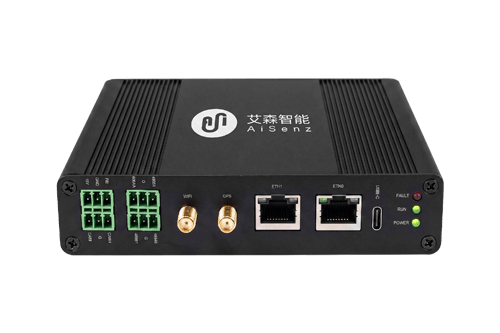
E680 runs a heterogeneous CPU of 4× Cortex-A72 (performance cluster) and 4× Cortex-A53 (efficiency cluster) alongside a 6 TOPS @ INT8 NPU and an ARM Mali-G52 MC3 GPU, so control workloads keep their timing guarantees while AI workloads get real compute. Interfaces cover 2× Gigabit Ethernet, 2× RS485, 1× CAN-FD, 1× GPS, 1× Wi-Fi and 2× USB Type-A, plus TF card expansion and a USB Type-C debug port — enough to connect essentially anything on an industrial site.
Edge LLM inference
The 6 TOPS @ INT8 NPU makes E680 one of the few industrial gateways able to run lightweight large language models such as Qwen 1.5B / 3B locally at the edge. With an on-device LLM, E680 delivers the following without any cloud dependency:
- Condition explanation: turns live SCADA data into natural-language operations summaries
- Root cause analysis: reasons over multi-source alarms and historical data to suggest likely causes and a troubleshooting path
- Optimisation advice: recommends operating parameter adjustments based on production plan, energy consumption and equipment health
- Natural language interaction: field engineers query equipment status and issue commands conversationally
- Privacy under your control: data never leaves the site, so sensitive process know-how and commercial secrets stay local
AIMesh Manager
The AIMesh Manager software runs natively on E680 and covers the full lifecycle of an AIMesh network:
- Topology visualisation: live view of AP01, M01 and D01 node topology
- Join management: allowlist, blocklist and automatic join policies
- TSCH slot scheduling: 6TiSCH scheduling policies configured and pushed from a visual interface
- Node OTA updates: batch firmware upgrades with staged rollout and rollback
- Link quality monitoring: live RSSI, LQI and packet loss for every mote node
- Buffering and replay: data is buffered locally through network disruption and forwarded automatically once the link recovers
Hardware at a glance
- Heterogeneous CPU: 4× Cortex-A72 + 4× Cortex-A53 — the performance cluster takes AI and video workloads, the efficiency cluster takes control and acquisition
- NPU: 6 TOPS @ INT8, supporting TensorFlow Lite, ONNX and RKNN model formats
- GPU: ARM Mali-G52 MC3 with OpenGL ES 3.2 and Vulkan 1.1, for HMI rendering and computer vision workloads
- Interfaces: 2× GbE / 2× USB Type-A / 2× RS485 / 1× CAN-FD / 1× GPS / 1× Wi-Fi / 1× TF / 1× USB-C debug
- Mechanical and environmental: 130 × 113 × 30 mm, 0.35 kg, 9–36 V DC, AVG. 3 W, −40 °C to +85 °C, DIN rail mounting
Typical applications
The AIMesh E680 edge gateway is deployed in high-value industrial scenarios:
- Edge brain for smart plants and workshops: with AP01, M01 and D01 it closes the full loop of sensing, access, compute, control and AI
- Edge node for predictive maintenance (PHM): vibration FFT and AI fault recognition run locally, with only conclusions and summaries sent upstream
- Energy optimisation and carbon management control: multi-source energy data is fused locally and AI produces real-time dispatch strategies
- AI visual inspection: with an attached camera and the NPU, defect detection, character recognition and assembly verification run on site
- Natural language interface for the plant: engineers query status, pull trends and issue commands in plain language
- Industrial AI agent testbed: the local LLM supports building process-specific industrial agents
Compared with conventional industrial gateways
Against the conventional split of protocol gateway plus AI server plus industrial PC, AIMesh E680 offers distinct advantages for Industry 4.0 and edge AI:
- One unit replaces three classes of device, saving cabinet space and power
- End-to-end latency drops by more than an order of magnitude, with the control loop closing entirely on site
- Data never leaves the site, which makes it easier for a project to meet the Chinese cybersecurity classification scheme (等保 2.0) and sector-specific compliance
- Unified operations through a web interface and OTA, so remote upgrades need no code
Key specifications
Engineering Credibility
Engineering guidance
Applications
Aggregates multi-protocol data and provides local buffering at station, campus or production-line edge.
Handles wireless uplink, device management, protocol adaptation and data forwarding.
Suits rule engines, anomaly detection, edge buffering and offline operating policies.
Deployment models
- Deployed in a station cabinet or at an edge node, connecting upstream to the customer private network, 4G/5G or the enterprise data centre.
- Downstream it takes AP01, RTUs, PLCs, sensors and third-party devices, normalising protocols in one place.
- Can be deployed in tiers alongside SCADA/HMI, ECS and the PHM SaaS.
Protocols
Specification checkpoints
- Check CPU, memory, storage, network ports, serial ports and long-term buffer capacity.
- Define local buffering, backfill, alarm retention and clock synchronisation behaviour for network outages.
- Edge applications need version management, logging, remote upgrade and access control.
Selection guidance
- Choose E680 when multi-protocol aggregation and edge applications are needed.
- Choose E680 Edge when AI video inference is required.
- Choose R580 or G001/G008 for straightforward RTU acquisition and control.
Reference topology
Field devices and wireless gateways connect to E680, which performs protocol conversion, buffering and edge rule processing before feeding SCADA, ECS, PHM or the enterprise platform.
Common pitfalls
- Treating E680 as an ordinary switch, wasting its protocol normalisation and edge buffering value.
- Not testing backfill after an outage, leaving data gaps when the public link fluctuates.
- Edge applications without version and log management, making field issues hard to trace.